
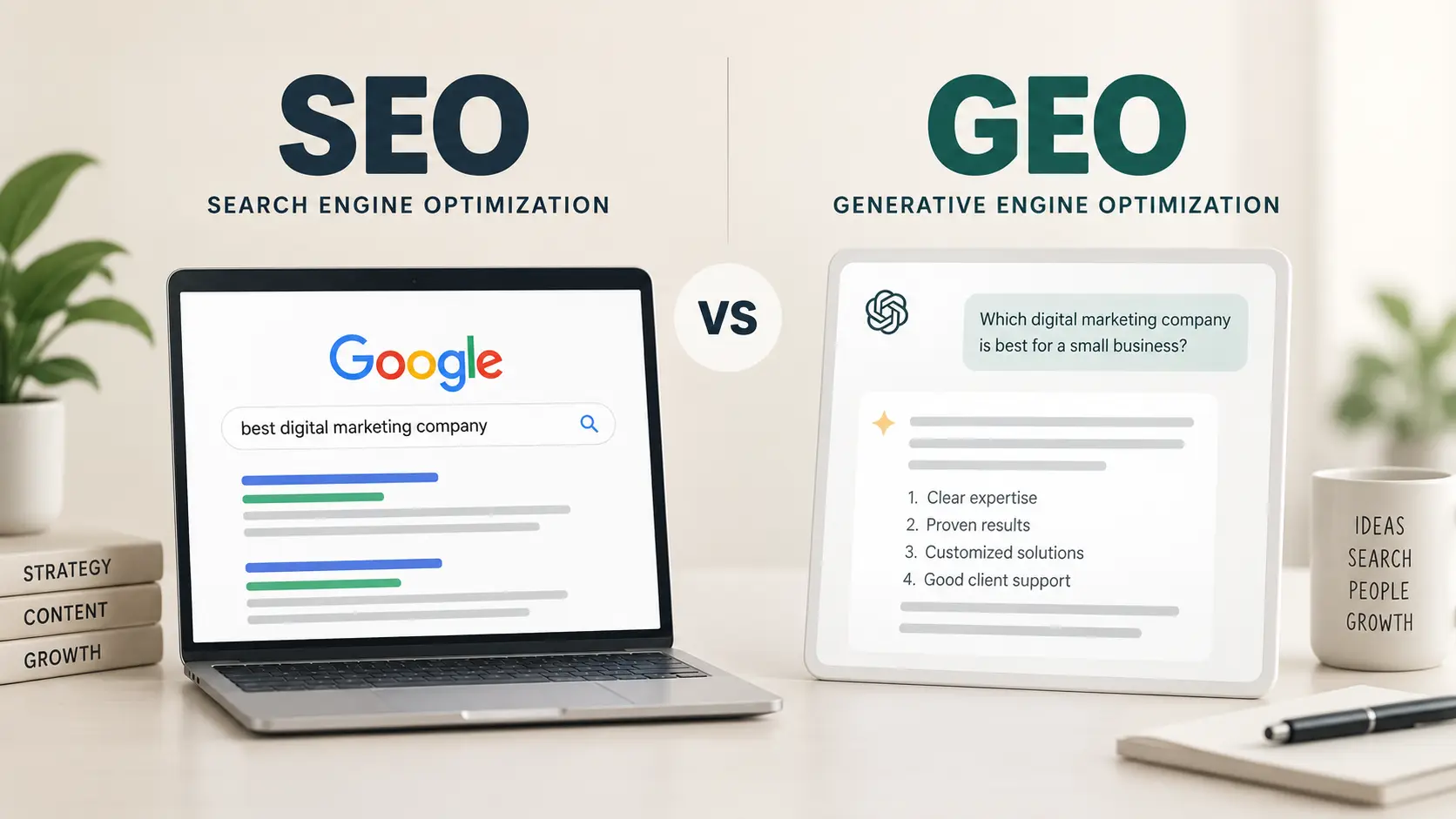
What if Google is no longer the only place your customers search?
Think about how people search today. Instead of typing only short keywords like best digital marketing company, people now ask AI tools complete questions:
- Which digital marketing company is best for a small business?
- How can I improve my website visibility?
- What company can help me optimise my business for AI search?
AI platforms are changing the way people discover businesses. Google Search is still important, but AI-powered search is becoming another major discovery channel. ChatGPT, Gemini, Perplexity and other AI tools can now provide direct answers, recommendations and summaries.
This is where the conversation around GEO vs SEO begins. If you want your business to remain visible in the future of search, you need to understand both traditional SEO and Generative Engine Optimisation.
What is Search Engine Optimization?
This is the process of optimising your site so that search engines like Google can understand your content and show it to the right people.
Typical SEO includes the following areas:
- Keywords
- Website architecture
- Site speed
- Link building
- Meta descriptions and titles
- Good content
- User experience
- Technical optimisation
If you are running a jewellery business and someone searches "buy silver jewellery online," then SEO helps your website show up in the search results.
The aim is simple: boost your site ranking and bring in the right visitors.
SEO remains essential. Your website still needs strong content, technical health and authority. But search behaviour is evolving, which is why businesses are now paying attention to AI search optimisation.
What Is Generative Engine Optimisation?
Generative Engine Optimisation, commonly called GEO, is the process of improving your online content so that AI-powered search engines can understand, use and potentially reference your business when generating answers.
Unlike traditional search engines, generative AI does not always simply display a list of ten blue links. Instead, it may analyse information from multiple sources and create a direct answer.
For example, a customer may ask an AI tool: "What should I look for when choosing an IT solutions company?" The AI may generate a detailed answer using information it finds across trusted sources.
With effective GEO optimisation, your business content is structured to make it easier for AI systems to understand:
- Who you are
- What services you offer
- Who you help
- What expertise you have
- Why your information is trustworthy
In simple terms: SEO helps search engines find your website, while GEO helps AI systems understand your business and content.
GEO vs SEO: What Is the Difference?
SEO and GEO are not enemies. You do not need to choose one and ignore the other. The smarter approach is to use both.
SEO focuses on:
- Search result ranking
- Keywords
- Organic traffic
- Technical website performance
- Authority and backlinks
Generative Engine Optimisation focuses on:
- AI-generated answers
- Structured, clear information
- Expertise and authority
- Question-based context
- Content that is easily understandable by AI
For example, SEO can help you rank for "artificial intelligence marketing services." However, GEO can help make your content useful when someone asks, "How can AI marketing help a small business get more customers?" That is exactly how many people interact with AI search platforms.
Why Does Your Business Need AI Search Optimisation?
Your customers are changing the way they search for information. People want straight answers and don't want to open several websites. They rely on AI tools to:
- Compare products
- Identify service providers
- Receive recommendations
- Learn about difficult subjects
This is a new opportunity for businesses. If your content provides clear, accurate and useful information, you have a better chance of becoming part of the AI search ecosystem. AI search optimisation can help your business build visibility beyond traditional search results. It also encourages you to create better content for real people, and that is always a good strategy.
How to Optimise for AI Search?
So, how do you actually optimise for AI search? Here are some practical steps.
1. Answer Real Customer Questions
Think about the questions your customers actually ask. Do not create content only around short keywords; create content around complete questions.
For example, instead of only targeting "website development company," you can also answer "How do I choose the right website development company for my business?" AI tools are designed to answer questions, so your content should do the same.
2. Make Your Content Clear and Easy to Understand
Avoid unnecessary jargon. Use:
- Clear headings
- Short paragraphs
- Bullet points
- Simple explanations
- Direct answers
AI systems and human readers both benefit from well-organised content. A page with clear sections is easier to understand than a large block of confusing text.
3. Demonstrate Real Expertise
Generic content is becoming less valuable. Your business should show real experience. Use examples from your industry, explain your processes, and share practical insights.
For instance, instead of saying "We provide excellent IT services," explain exactly what you do: "We help businesses improve their websites, digital presence and technology systems through customised IT solutions." Specific information creates better understanding and also improves trust.
4. Build Trust and Authority
Trust matters in both SEO and GEO optimisation. Make sure your website clearly shows:
- Your company information
- Your services
- Your expertise
- Author or business credentials
- Contact details
- Real case studies or examples
- Updated information
AI systems aim to provide useful and reliable answers. Strong, trustworthy content gives your business a better foundation.
5. Keep Your Information Updated
Outdated information can hurt your visibility. Review your important pages regularly and update:
- Services
- Statistics
- Company information
- Industry trends
- Product details
Fresh and accurate information helps both customers and search systems.
The Future Is Not GEO Instead of SEO
The biggest mistake businesses can make is thinking that SEO is finished. It is not. Traditional search still drives significant traffic and remains an important part of digital marketing.
The future is better understood as SEO + Generative Engine Optimisation + high-quality content. Your website should be technically strong enough for search engines, your content should be useful enough for people, and your information should be clear enough for AI systems to understand. That is the foundation of modern search visibility.
Conclusion
Start preparing your business for AI search. AI is changing how people discover information, products and businesses. This does not mean you need to abandon your existing SEO strategy; instead, build on it.
Focus on creating helpful content. Answer customer questions clearly. Demonstrate real expertise. Keep your website trustworthy and well structured. That is how you can begin to optimise for AI search while continuing to perform well in traditional search engines. Businesses that start adapting now will be better prepared as AI-powered search becomes a bigger part of the customer journey.
At Thea IT Solutions, we help businesses understand the changing digital landscape and build stronger strategies for search visibility, SEO and the future of AI-driven discovery.
FAQs
1. How can businesses improve their chances of appearing in AI search results?
If your content provides clear, accurate and useful information, you have a better chance of becoming part of the AI search ecosystem.
2. What are the benefits of AI Search Optimisation for businesses?
AI search optimisation can help your business build visibility beyond traditional search results. It also encourages you to create better content for real people, and that is always a good strategy.
3. Why is AI-powered search becoming an important channel alongside Google Search?
Google Search is still important, but AI-powered search is becoming another major discovery channel. ChatGPT, Gemini, Perplexity and other AI tools can now provide direct answers, recommendations and summaries.